Written by Karthik Ravi, CFA
How to collect cash upfront while setting discounted stock buying targets
Educational Disclaimer: This publication is for educational and informational purposes only. It does not constitute personalized financial, tax, or investment advice. Options trading carries substantial risk and is not suitable for all investors. Always perform your own research and make independent financial decisions.
Key Takeaway in Plain English
A cash-secured put allows you to get paid cash today in exchange for agreeing to buy 100 shares of a stock you like at a lower target price in the future. You hold cash as collateral, eliminating margin debt while lowering your effective cost basis.
1. What Is a Cash-Secured Put?
If you have ever set a limit order to buy a stock at a discount, you already understand the core concept. With a standard limit order, you wait for free. With a cash-secured put, someone pays you an upfront fee (a premium) just for promising to buy the stock if it dips to your price.
Let’s unpack the three terms:
- Put Option: A contract giving the buyer the right to sell 100 shares of a stock at a specified price (the strike price) before an expiration date. As the seller of the put, you accept the obligation to buy those 100 shares if assigned.
- Secured: You have fully collateralized the trade so you are never forced to borrow money or trade on leverage.
- Cash: The collateral set aside sits as liquid cash in your brokerage account to cover the entire stock purchase.
2. Visualizing the Mechanics and Payoff
CASH-SECURED PUT PAYOFF AT EXPIRATION (PLAIN ENGLISH EXAMPLE)
- SELECT STOCK: Example: XYZ Corp
- SET STRIKE & SECURE CASH: Choose $100 Strike, Lock $10,000 Cash
- COLLECT PREMIUM: Receive $300 upfront
| Outcome / Metric | Value |
| Max Profit | Premium Received: $300 |
| Strike Price | $100 |
| Breakeven Point | $97 ($100 Strike – $3 Premium) |
| Loss Zone | If stock falls below $97 (Effective cost is $97) |
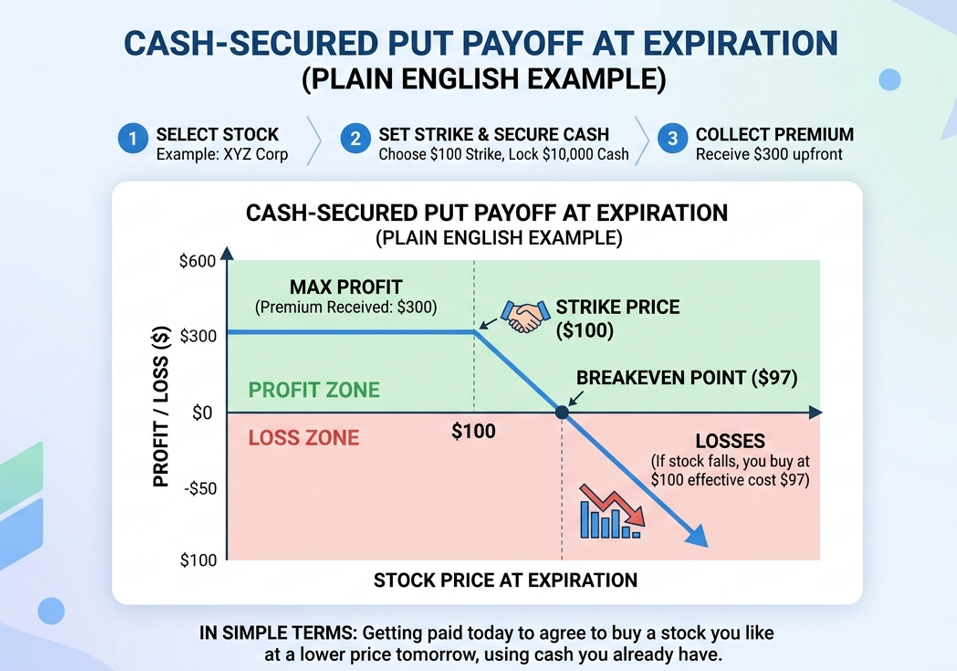
Figure 1: Visual breakdown of cash-secured put zones, strike price ($100), and breakeven point ($97).
(Note: Figure 1 illustration was generated using DALL-E.)
IN SIMPLE TERMS: Getting paid today to agree to buy a stock you like at a lower price tomorrow, using cash you already have.
As shown in the mechanics above, the strategy creates two distinct outcomes at expiration:
- Stock Price Stays Above Strike ($100): You keep the entire upfront premium ($300) as pure profit, and your cash collateral is unlocked.
- Stock Price Falls Below Strike ($100): You are assigned 100 shares at the $100 strike price. However, because you received $3.00 per share ($300 total) upfront, your net effective cost basis is reduced to $97.00 per share.
3. The Real-World Analogy: Real Estate Earnest Money
Imagine a home listed at $500,000. You like the house, but only at $470,000. You tell the owner:
“I will lock $470,000 in cash in an escrow account for 30 days. You have the right to sell me the house for $470,000 anytime this month. For keeping my money locked up and offering this guarantee, you must pay me a non-refundable $5,000 cash fee right now.”
If the house value rises, the owner keeps the house, and you walk away with your $470,000 plus the $5,000 fee. If the market cools, the owner sells you the house at $470,000, but your net outlay is $465,000 because of the initial $5,000 payout.
4. Step-by-Step Execution Checklist
| Step | Action Item | Practical Example |
| Step 1 | Select a high-conviction stock | XYZ Corp trading at $105/share |
| Step 2 | Choose Strike Price & Expiration | $100 Strike Price, 30 Days Out |
| Step 3 | Lock Cash Collateral | Required Cash = $ Strike X 100 = $100 X $100 = $10,000 |
| Step 4 | Sell to Open & Collect Premium | Receive $3.00/share = $300 immediate cash |
Breakeven Point = Strike Price – Premium Received per Share
Example: $100 – $3.00 = $97.00
5. Scenario Analysis at Expiration
Assuming XYZ Corp was at $105 when you sold the $100 Put for $3.00 premium ($300 total):
- Scenario A — XYZ closes at $108 (Stock Rallies): Option expires worthless. You keep $300 profit (3.0% return on $10,000 locked capital in 30 days). Collateral released.
- Scenario B — XYZ closes at $101 (Stock Dips Slightly): Option expires worthless because $\$101 > \$100$. You keep $300 profit.
- Scenario C — XYZ closes at $92 (Stock Drops Moderately): You are assigned 100 shares at $100. Your cash collateral buys the shares. With the $300 premium kept, your cost basis is $97/share (better than buying at $105 initially).
6. Risks of the Strategy
While selling cash-secured puts generates immediate income, it exposes you to three primary risks:
- Downside Price Risk: If the stock crashes to $60 due to earnings or macro shifts, you are still obligated to buy at the $100 strike price. While the $3.00 premium lowers your effective cost basis to $97, you absorb all further capital losses below $97. Always ensure you genuinely want to hold the company long-term regardless of short-term volatility.
- Capped Upside Potential: Your maximum potential profit is strictly capped at the upfront premium collected ($300). If the stock skyrockets, you do not participate in any price gains above the $300 fee.
- Opportunity Cost of Capital: Your $10,000 cash collateral remains locked for the duration of the trade and cannot be deployed into other market opportunities.
7. Summary Comparison: Limit Order vs. Cash-Secured Put
| Feature | Standard Limit Order | Cash-Secured Put |
| Gets Paid While Waiting | No ($0) | Yes (Collects Premium) |
| Cost Basis Reduction | None | Reduced by Premium |
| Upside Participation | None until filled | Capped at Premium Collected |
| Capital Required | Set aside upon order | Set aside as Collateral |